Biography of Jeannette Weiss Gruber
Biography
Jeannette Weiss Gruber, born on July 1, 1934, in Paris and died in the same city on June 7, 2026, was a French stained-glass painter. She was the daughter of the master glassmaker Jean-Jacques Gruber and the granddaughter of Jacques Gruber, a leading figure of the École de Nancy. She was the mother of Frédéric, Camille and François Weiss.

Training and career
In the family workshop she grew up among old stained-glass windows, hidden and kept safe under her father’s authority during the war, then stored at the Château de Champs-sur-Marne at the Liberation. Some were later reinstalled on site. At the age of ten, she promised herself she would make windows “prettier” than those in the workshop.

At eleven, a 30 kg stone crushed her right hand. Reattached after a twelve-hour train journey, the hand was saved, but the wrist remained slightly crooked. “A para-artist,” she would say; she developed a way of working all her own.
After the war, with her childhood friends, she watched the Chartres windows being reinstalled, still free of pollution. At eighteen, she was enthralled by the Tree of Jesse (Le Prince) at the Pavillon de Marsan, and by Chagall’s windows for Hadassah. She admired the stained glass of the great painters, especially Miró’s windows in Senlis.

From 1954 to 1969 she worked in the family workshop, where she had the privilege of seeing old windows up close while they were being restored. Recognition was hard to come by at first in a family workshop dominated by her father and her brother.
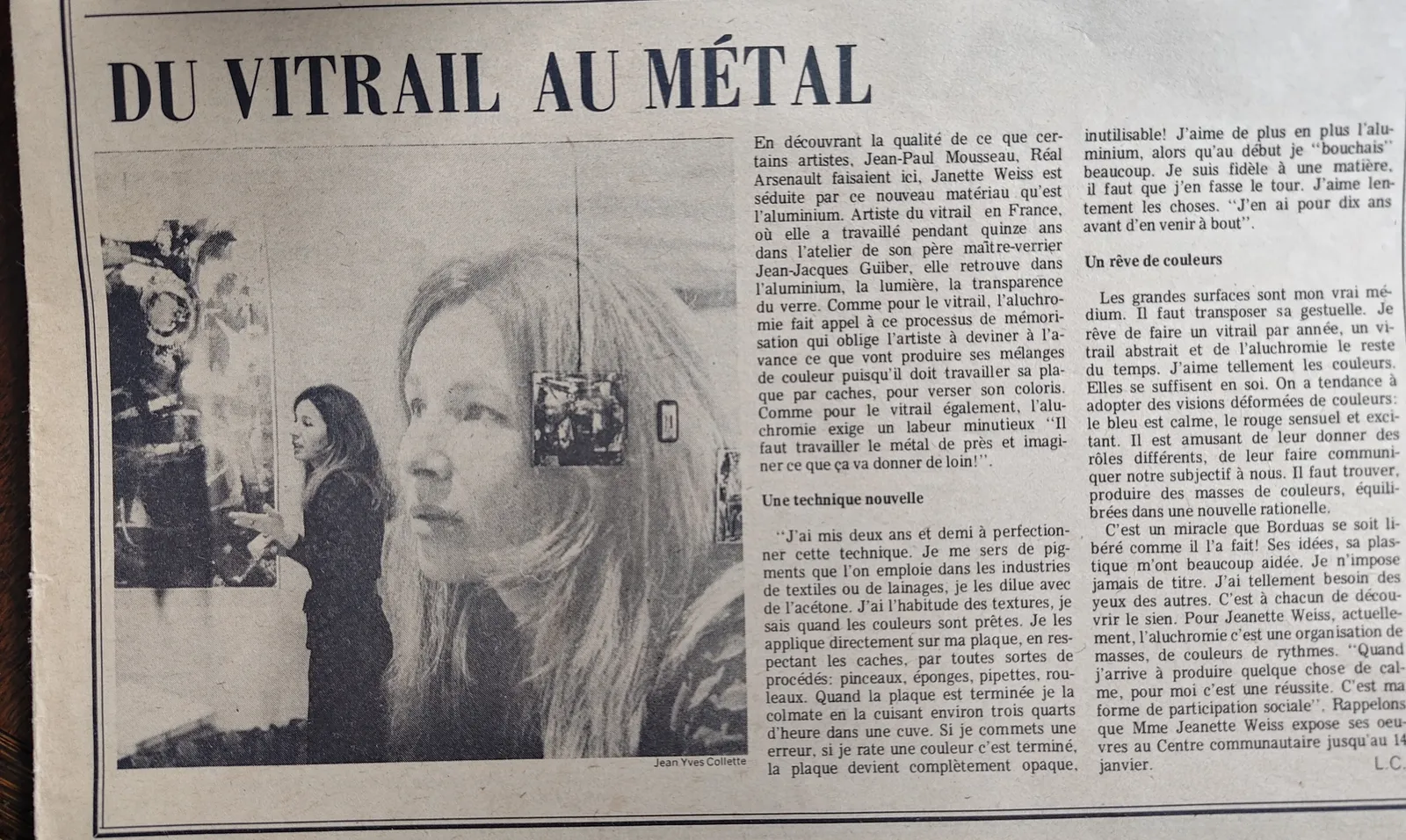
In 1969 she moved to Quebec with her husband and children (1969–1973), where she worked with light just as she worked grisaille on her windows. At the request of the Alcan plants, she experimented with oxidized aluminum and pigments used for dyeing wool: this gave birth to her aluchromies (paintings on aluminum).
Back in Paris in 1973, she taught art history for an American school. The same year, she received the Arts et Métiers diploma in cutting and assembling stained glass. In 1980 she took over part of the family workshop at the Villa d’Alésia and adopted the signature JWG. For assembly, glass cutting and installation, she was helped by former students she had known at the Métier d’Art and by two master glassmakers.

Technique and approach
From 1958 she developed a method combining combs and sponges, complemented by badger brushes and paintbrushes depending on the project, a process used notably for the two windows of the Chapel of Saint Joseph in the primatial Cathedral of Saint-Jean in Lyon (1978). White and blue were her favorite colors, with careful work in grisaille.
She insisted on working in daylight, the only condition, in her view, for judging honestly the texture and chromatic vibration of the glass. She expressed herself more freely high up in a window, where there are fewer constraints.
She also had an original way of visualizing her work: looking at her windows through binoculars turned the wrong way round, to anticipate how they would read from a distance in situ and to fit them better into the building.

For her, three quarters of her work was in her eyes.
Aymeric Zublena (Médaille de la Restauration, 2001) sums up her intent: “To set her creations in place by steeping herself in the architectural setting and the light, seeking harmony with the existing windows while avoiding any pastiche.” According to him, from 1955 to the present day she moved between figuration, allusion and abstraction, always favoring dialogue with the context and the public.
Jeannette said: “Stained glass is in my skin; when I make my full-size cartoons, the leading is already there (for my layout on tracing paper).”

Donations and archives
She made numerous donations relating to the work of her grandfather Jacques Gruber and to her own workshop (cartoons, maquettes, site files for the Historic Monuments and restoration files) to the Médiathèque de l’Architecture et du Patrimoine (Ministry of Culture, 2005).
She also had the curved stained-glass window above the workshop’s inner door (the former Jacques Gruber workshop) restored and donated it to the Musée des Arts décoratifs in Paris. In 2022 she deposited the Seagulls window there.
Reception and recognition
She valued the recognition of the DRACs, the inspectors of Historic Monuments, the chief architects and her friends, historians of stained glass, who had watched her work. Past the age of 90, she still sometimes woke at night, preoccupied by these matters.
In 2001 the Fondation de l’Académie d’Architecture awarded her the Médaille de la Restauration, honoring the excellence of her work in creation and restoration and her contribution to the renewal of stained-glass art in France.

Jeannette walking
Tribute
Jeannette Weiss Gruber passed away on June 7, 2026, in Paris, at the Maison médicale Jeanne Garnier, surrounded by her children, at the age of 91.
A ceremony in her honor was held on Thursday, June 18, 2026, under the dome of Père-Lachaise, where her family, friends and peers paid tribute to her memory as a painter and master glassmaker, an art historian and a loving woman.